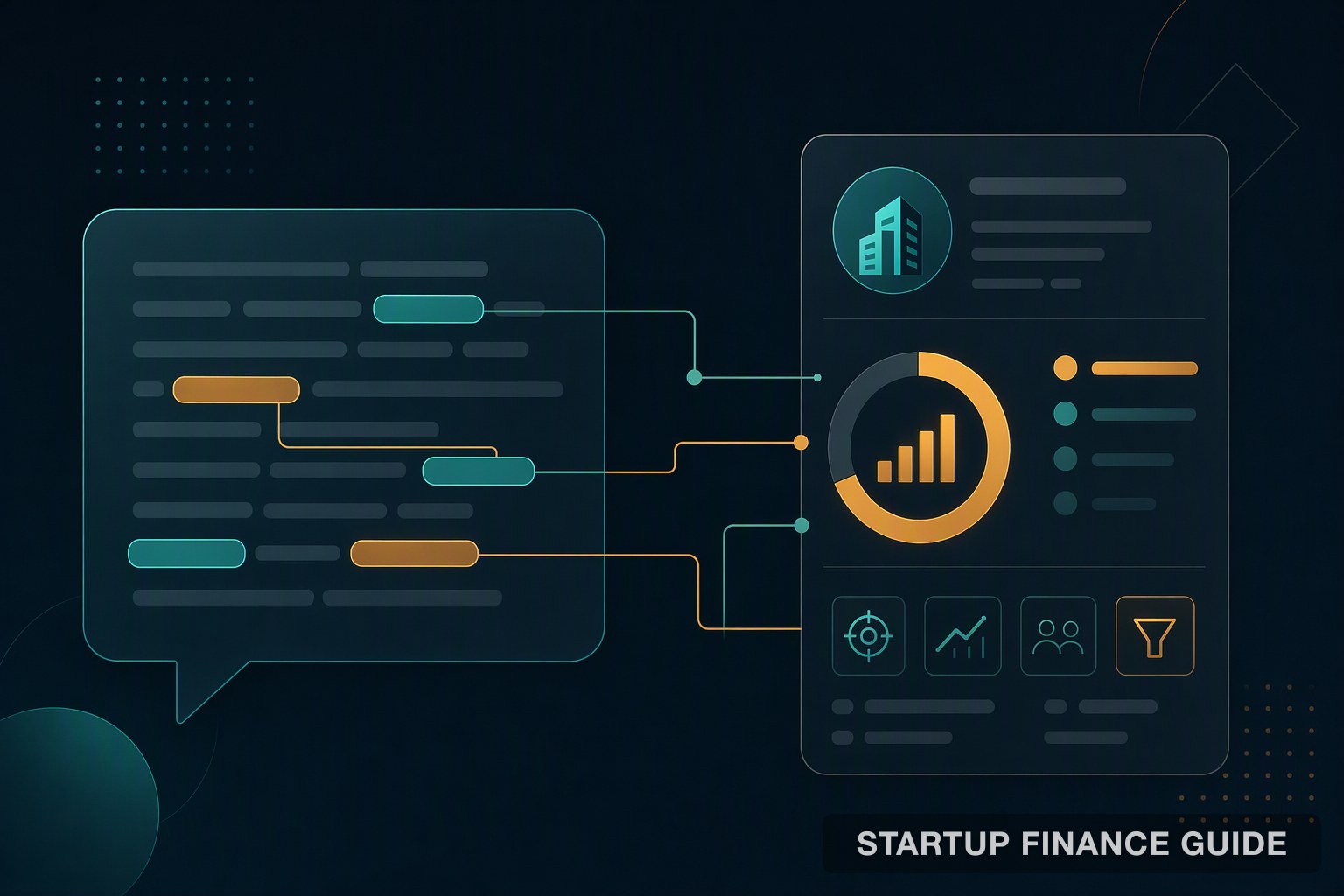
7 Conversational AI Platforms That Understand Buyer Intent
Seven conversational AI platforms for detecting buyer intent, chosen by channel rather than by model, because intent can only be scored where it is stated. Two of the seven are now Salesforce products, which changes the roadmap question on any multi-year deal. Demand traceability from every score to the call, ticket or event behind it, and backtest on your own won and lost deals before signing.
This article is for informational purposes only and does not constitute financial, tax, or legal advice. Consult a qualified professional for guidance specific to your situation.
Reviewed for financial accuracy by the Startup Finance Guide editorial team. Our editors cross-reference all claims against platform documentation, pricing pages, and primary regulatory sources. Last reviewed: November 2, 2026.
Intent can only be scored where it is stated, which makes the channel your buyers use first the deciding factor. Quivly reads calls, email, Slack, product usage and billing for post-sales teams. Gong reads sales calls, emails and meetings. Qualified, now owned by Salesforce, works the website in real time. Fin, the company formerly called Intercom and also now part of Salesforce, handles support conversations at $0.99 per outcome. 6sense covers account-level research signals, Amplitude ties product behaviour to feedback with 2M events a month free, and Captify reads search and, since 2026, opted-in AI chat activity for advertisers.
A prospect types "can your enterprise plan cover 400 seats by October?" into a chat window, and the answer sits in a transcript nobody reads until Friday. The budget, the timeline and the objection were all stated plainly. The CRM recorded none of them.
Key takeaways
- Buyers state intent in plain language: a named plan, a seat count, a go-live date, a competitor. The tool's job is to catch the statement and route it to a person within the day.
- Pick by channel first. A platform that cannot read the channel where your buyers speak first cannot score what they said, whatever its model does.
- Ownership has shifted. Two of these seven are now inside Salesforce, which changes the roadmap question in any multi-year deal.
- Intent data is already standard. In Gartner's 2023 technology marketing benchmarks survey, 93% of technology marketers at companies with $100 million or more in annual revenue used third-party intent data for at least one use case. What conversational data adds is the thing those feeds cannot see: what the buyer actually said.
The seven compared
| Platform | Signal source | Pricing | Ownership |
|---|---|---|---|
| Quivly | Calls, email, Slack, CRM, usage, billing, support | Quoted | Independent |
| Gong | Calls, emails, meetings | Quoted | Independent |
| Qualified | Website visitors and inbound email | Quoted | Salesforce, acquisition closed April 2026 |
| Fin, formerly Intercom | Support conversations across channels | $0.99 per outcome; qualifications $9.99 | Salesforce, acquisition completed 10 September 2026 |
| 6sense | Web activity, intent network, CRM | Quoted | Independent |
| Amplitude | Product behaviour, surveys, reviews, tickets | Free to 2M events a month | Public company |
| Captify | Search intent, zero-party data, opted-in AI chat | Quoted | Verve Group |
What counts as an intent signal
- A specific request: a named feature, plan or integration.
- Comparison language: a competitor or an alternative mentioned by name.
- A constraint: a budget, a seat count, a go-live date.
- A repeated need: the same problem raised across several conversations.
- Support friction: a question that reveals a blocker in the current product.
The fifth one is where most teams lose signal, because it arrives in a support queue rather than a sales call and nobody connects it to the renewal.
The conversation platforms
Quivly
An AI workforce for post-sales teams, turning what customers say in calls, email and Slack into scored actions, following each account from onboarding through renewal and drafting the next step for a person to approve. Account briefs link claims back to their source and flag low-confidence signals rather than guessing, and its Radar picks up outside events such as a customer acquiring another company and surfaces them as expansion signals.
Best for: B2B SaaS post-sales teams where each person carries more than fifteen accounts and the intent that matters is expansion or renewal rather than new business.
Gong
A revenue AI platform capturing calls, emails and meetings. Its Revenue Graph connects interactions across the go-to-market team to feed forecasting and coaching, trackers flag competitor mentions and objections across conversations, and Gong Agents automate follow-ups, pipeline edits and forecast corrections with human review in the execution path.
Best for: enterprise revenue teams with high call volume that need coaching, forecasting and deal insight in one place.
Qualified
An agentic marketing platform built around Piper, an AI SDR that greets website visitors, answers questions and books meetings during the conversation rather than behind a form. Piper Email continues the thread after the visitor leaves.
Salesforce agreed to acquire Qualified in December 2025 and closed in April 2026, with Piper positioned as the AI SDR layer on the Salesforce platform. Separately, Salesloft and Clari announced a gradual sunset of Drift in March 2026, which pushed a cohort of teams into this comparison.
Best for: B2B marketing teams with steady inbound traffic and a sales team that wants meetings rather than form fills. Ask about: what the Salesforce acquisition means for standalone pricing and integrations.
Fin, formerly Intercom
The AI customer agent from the company that renamed itself Fin in 2026, resolving queries across live chat, email, SMS, WhatsApp, voice, Slack and social, and handing conversations to human teams with full context on Intercom, Salesforce, HubSpot, Freshworks, Zoho and others. Fin for Sales handles inbound sales conversations specifically.
Pricing is unusually transparent for this category: $0.99 per outcome, covering resolutions, procedure handoffs, disqualifications and self-serve routings, with qualifications at $9.99 each. That structure rewards you for routing correctly rather than for volume.
Salesforce completed its acquisition of Fin on 10 September 2026. Its documentation refers to a proprietary Fin AI Engine rather than naming underlying models, and it publishes benchmarks rather than a single headline resolution rate, so treat any specific percentage you see quoted elsewhere with care.
Best for: support and success teams that want an agent handling first-line conversations and surfacing sales interest from them.
The account and product signal platforms
6sense
An account-based platform showing which accounts are researching your category and predicting where each sits in the buying process. Its predictive model runs on what it calls the Signalverse, which it says processes more than a trillion buyer signals a day. RevvyAI answers questions about pipeline, accounts and campaigns in plain language, and its AI Email Agents run the email motion from first prompt to qualified lead.
Best for: enterprise B2B teams running account-based programmes with RevOps support. Where it stops: this is account-level inference, not what an individual said. It tells you a company is in-market, not what the buyer told you.
Amplitude
Ties what users do inside a product to what they say about it, with reviews, surveys and support tickets sitting beside the usage data behind them, so a feature request arrives with context. Feedback can be labelled automatically with alerts when a category spikes, and its AI agents answer questions across analytics, session replay and feedback.
Its free tier is genuinely usable: 2 million events a month, 2,000 AI feedback records, 10,000 session replays and unlimited feature flags.
Best for: product-led teams wanting self-reported friction and expansion cues next to in-product behaviour.
Captify
A search intelligence platform, part of Verve, built for advertisers rather than for sales teams. The company says it captures more than a billion daily onsite search intent and zero-party signals across web and in-app environments drawn from over 3 million websites, and that in 2026 it added conversational signals from AI chat environments, sourced from users who consent to share pseudonymised chat activity through apps they already use.
Best for: advertisers and agencies buying media who want to target by what people ask search engines and AI assistants. Where it stops: this is audience targeting, not account intelligence, and the figures above are the company's own.
How to choose
- Map where buyers speak first. Website chat, sales calls, support tickets, in-app. Cut anything that cannot read your top three, because a platform scoring the wrong channel produces confident, irrelevant answers.
- Demand traceability. Ask for a live account where each score links back to the call, ticket or event behind it. A score without a source is a guess with a number attached. Our roundup of AI customer insight tools that generate revenue signals judges tools on exactly this.
- Set an approval rule for outbound. Human review on anything customer-facing, and ask what the tool does when its own confidence is low. Our guide to guardrails for an AI agent that emails customers covers where that enforcement has to sit.
- Confirm ownership and roadmap. Two of these seven are now Salesforce products. Ask how that affects pricing, integrations and support before signing anything multi-year.
- Price the pilot against pipeline. Write down what one qualified meeting or one saved renewal is worth, then measure the ROI after 90 days against that number rather than against activity.
Limitations
Capabilities, pricing and ownership come from each vendor's own pages and public announcements as checked in November 2026, in a category that has consolidated twice this year. Figures quoted for signal volumes are the vendors' own and are not independently verifiable. We could not confirm a headline resolution rate for Fin from its own documentation, so none is quoted, and we have not tested intent detection accuracy on any platform. The Gartner figure describes technology marketers at large companies and may not generalise to other segments.
Frequently asked questions
Is conversational intent better than third-party intent data?
Different, and complementary. Third-party feeds tell you a company is researching your category. Conversational data tells you what a specific person said they need. The first fills the top of the funnel; the second decides what you say next.
Can one platform cover both sales and support intent?
Rarely well. Fin sits in support and surfaces sales interest, Qualified sits on the website, Gong sits on calls. Most teams above a certain size run two and connect them at the CRM.
How accurate is intent scoring?
Nobody publishes a figure you can rely on, and the ones vendors do publish are measured on their own data. Backtest on your own history before believing any of it.
What does per-outcome pricing change?
It moves the risk to the vendor and makes the bill predictable per interaction rather than per seat. Read the definitions carefully, because what counts as an outcome varies and the per-unit prices differ sharply between categories.
Does AI chat activity count as intent data?
It can, where users have consented to share it. Treat consent and provenance as diligence questions rather than assuming, because this is a new signal category and the sourcing practices are not yet standardised.
Conclusion
Run a backtest before you sign. Pull twenty deals or renewals from the last two quarters, ten won and ten lost, and read the first conversation on each. Write down the moment a buyer stated a budget, a deadline or a competitor.
Then ask each finalist to replay those conversations and show when its platform would have raised a flag. You get three numbers: how many signals it caught, how early, and how many alerts led nowhere. A platform that catches most and stays quiet on the rest is ready for a pilot. One that cannot show its work on history will not prove itself on live accounts either.
Capabilities, pricing and ownership come from each vendor's own pages and public announcements as checked in November 2026, in a category that consolidated twice this year. Signal volume figures are the vendors' own and are not independently verifiable.
How we built this comparison: ownership and pricing come from vendor pages and acquisition announcements, and where a vendor does not publish a figure, such as an average resolution rate, we leave it out rather than repeat one from elsewhere.
Last verified: 2026-11-02