The Cheapest Way to Cover Customers Without a CS Team
A tiering model and five low-cost tools for covering customers without hiring a CSM. SaaStr's rule of thumb is roughly 10% of revenue on customer success and support plus one CSM per $2M ARR, which is why automating the long tail matters at seed stage. Define the activation milestone and the account tiers before buying anything, and measure milestone completion against a holdout rather than email opens.
This article is for informational purposes only and does not constitute financial, tax, or legal advice. Consult a qualified professional for guidance specific to your situation.
Reviewed for financial accuracy by the Startup Finance Guide editorial team. Our editors cross-reference all claims against platform documentation, pricing pages, and primary regulatory sources. Last reviewed: November 2, 2026.
Tier accounts by value first. Spend human time on the top tier only. Let tools handle everyone else based on what they actually do in the product. Five tools make that workable on a small budget: Userlens has a free plan and a $100 a month Starter, PostHog is free up to generous monthly limits, Customer.io starts around $100 a month with twelve months free for startups that have raised under $10 million, Userpilot's Starter is $299 a month for up to 2,000 monthly active users, and Appcues covers up to 3,000 monthly active users on its Start plan without publishing a price.
Ten new logos sign and the reflex is to post a CSM job ad. SaaStr's rule of thumb is to budget roughly 10% of your revenue base for customer success and support once you are past early traction, and to add about one CSM per $2 million in ARR. That is a real number against a seed-stage plan, and it arrives before the revenue does.
Key takeaways
- Tier first, buy second. Every tool here needs an activation milestone and account tiers defined before it knows who to nudge.
- Venture investor Tomasz Tunguz, working from a Gainsight survey, found most CSMs manage $2 to $5 million in ARR across anywhere from 10 to 500 accounts depending on segment. That spread is the argument for automating the long tail.
- The data gap is the opening. The Customer Success Collective reports that 65.6% of CS teams track usage data while only 15.6% of companies proactively gather direct feedback during onboarding.
- Measure milestone completion against a holdout, not email opens. A tool that cannot show behaviour change is not covering anything.
The three-tier model
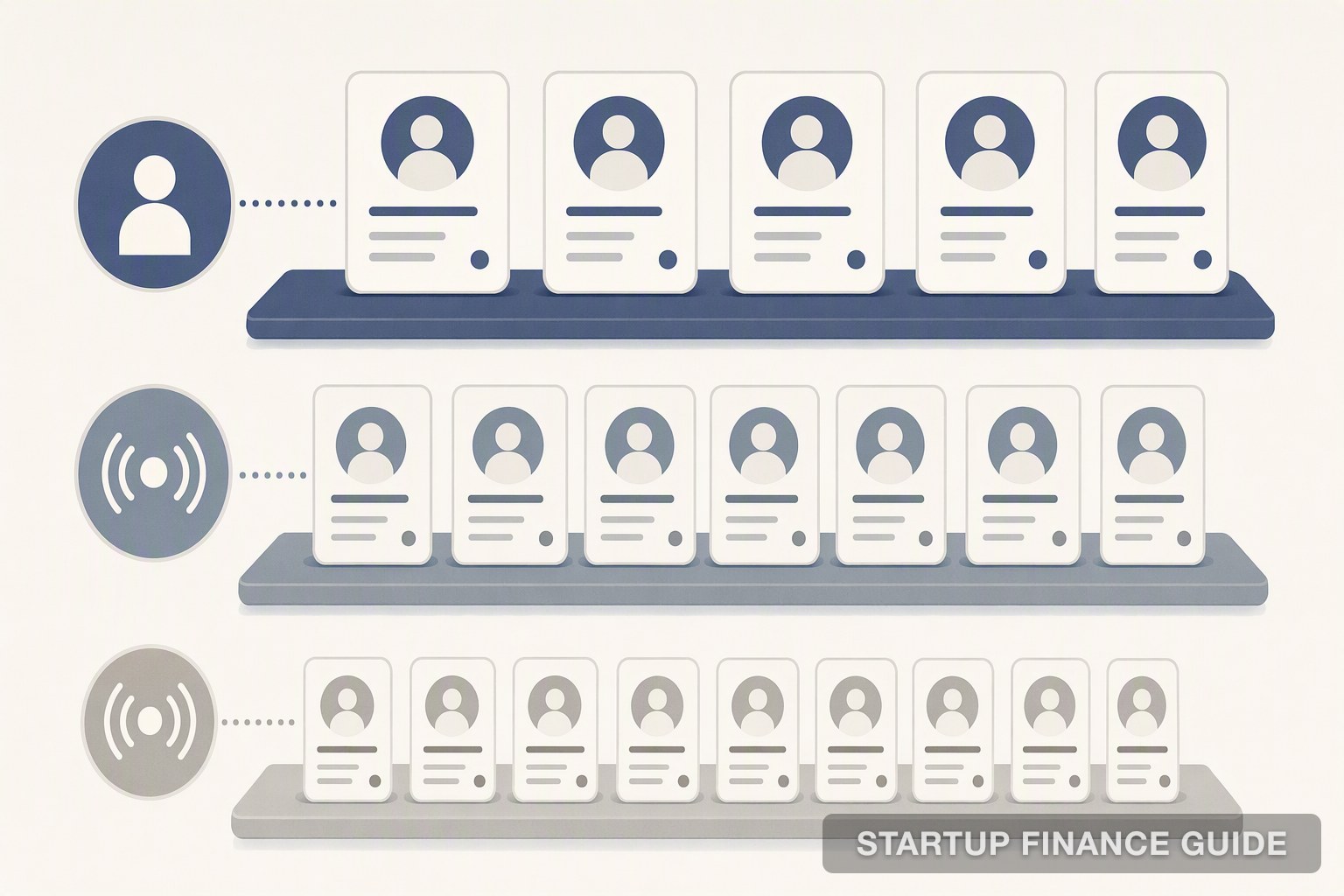
Most lean teams land on three tiers:
- High-touch: strategic accounts get calls and proactive health reviews from a person.
- Low-touch: mid-market gets triggered playbooks plus a periodic personal check-in.
- Tech-touch: the long tail gets automated guidance only, an onboarding series and a rescue message when usage drops.
A single operator can run the whole thing in three weekly blocks: a health review of the top tier, exception handling for whatever the automation flagged but could not resolve, and playbook upkeep to retire the nudges that moved nothing.
The five tools compared
| Tool | Entry price | Free option | Entry limits | Channels |
|---|---|---|---|---|
| Userlens | Free, then $100/mo Starter | Yes | Free: 100 profiles, 300 emails a month, 1 campaign. Starter: 10,000 profiles, 10,000 emails, 5 campaigns | Email and Slack |
| PostHog | Free, then pay as you go | Yes, monthly allowance | 1M analytics events, 5,000 session recordings and 1,500 survey responses a month | Analytics, surveys |
| Customer.io | From about $100/mo | 12 months free for startups that raised under $10M | 5,000 profiles, 1M emails a month | Email, in-app, push, SMS, WhatsApp |
| Userpilot | $299/mo Starter | 14-day trial | Up to 2,000 monthly active users | In-app, email |
| Appcues | Not published | Trial | Start plan: up to 3,000 monthly active users, 10 published experiences | In-app, email, push |
| Prices come from each vendor's own pricing page as checked in November 2026. Two of the five do not publish full pricing, which is noted in each entry below. |
The five in detail
1. Userlens
A customer adoption and retention engine for B2B SaaS. It connects your product database and analytics, builds a profile for each account and person, and uses its agent, Lumi, to send email or Slack nudges inside campaigns a human approves.
What sets it apart is that nudges are written from the individual's own behaviour rather than a segment label, so the message can point at something the person actually did. A human approves the goal, audience, tone and limits for each campaign, and frequency caps, quiet hours, never-contact flags and a kill switch are enforced before sending. A scoreboard tracks whether the target behaviour changed.
Pricing: Free covers 100 profiles, 300 personalised emails a month and one active campaign. Starter at $100 a month covers 10,000 profiles, 10,000 emails and five campaigns. Growth starts at $1,000 a month billed annually.
Best for: founders and lone operators with a product database or PostHog already in place and no time to hand-build segments. Not for: teams needing in-app guidance, since the channels are email and Slack.
2. PostHog
Product analytics, and the foundation everything else sits on, because every behaviour trigger needs events to fire from. The free monthly allowance covers 1 million analytics events, 5,000 session recordings and 1,500 survey responses, with unlimited team members, and billing limits can be set per product so usage does not turn into a surprise invoice.
Best for: teams with no usage tracking yet. Start here before buying anything that sends messages. Not for: messaging, which it does not do.
3. Customer.io
A messaging platform that sends email, in-app messages, push, SMS and WhatsApp based on the data you send about each person. Segments update themselves as people meet or stop meeting conditions, which makes a rule like "no key action in seven days" straightforward, and the visual workflow builder handles multi-step journeys across channels.
Its startup programme gives twelve months free to companies that have raised under $10 million, which is the most generous offer on this list by some distance.
Best for: technical founders with an engineer who can send events and who want full control over the logic. Not for: teams without that engineer, because you build the event taxonomy, the logic and the templates yourself.
4. Userpilot
In-app engagement, analytics and feedback in one tool, aimed at teams whose users are in the product daily. Flows, spotlights, banners and checklists guide users to key actions without code, and NPS surveys are included on the entry plan rather than sold separately.
Pricing: Starter is $299 a month for up to 2,000 monthly active users. Growth starts at $849 a month.
One caveat: its pricing page lists an MCP server and the Lia AI agent in each plan's feature list, while the detailed comparison table marks agent and MCP analytics as add-ons on higher tiers. Confirm what the Starter plan actually includes before buying on that basis.
Best for: product-led teams whose customers log in daily.
5. Appcues
A no-code platform for in-app onboarding and adoption experiences: modals, tooltips, slideouts, banners, checklists and surveys, alongside behavioural email and push from the same place. Native integrations cover Segment, HubSpot, Mixpanel and Salesforce.
Pricing is the catch. Appcues does not publish prices. Its Start plan covers up to 3,000 monthly active users with 10 published experiences, Grow starts at 3,000 with 25, and Enterprise is custom with 100. A separate Spark programme is described as built for small teams shipping their first in-app experiences, also without published pricing. Figures quoted elsewhere online for an annual Appcues fee or a setup charge do not appear on its pricing page, so get a quote rather than planning around them.
Best for: small teams that want a first onboarding flow live quickly and can tolerate a sales conversation to find out the price.
Choosing between them
- Customers log in daily: Userpilot or Appcues, so the guidance meets them inside the product.
- Customers use the product in the background: Userlens or Customer.io, so nudges reach them outside it.
- No usage data yet: PostHog first. Nothing else works without events.
- No engineer available: Userlens or Appcues, which connect to existing data rather than requiring an event taxonomy.
Pairing keeps the bill down. Userlens Starter plus free PostHog is about $100 a month. Adding Userpilot Starter takes it to roughly $400. Our comparison of CSM replacements for product-led SaaS covers the same question from the staffing side, and affordable customer success tools for SaaS startups goes wider on the budget end of the category.
Setting up your first trigger
- Pick one activation milestone: the single action that predicts retention, such as inviting a teammate or exporting a first report.
- Send the events: that action plus a few related ones, from your product into your analytics or messaging tool.
- Define a stalled segment: accounts that have not hit the milestone within seven days of signup.
- Write one nudge: short, tied to that milestone, with a clear next action.
- Measure behaviour, not opens: compare milestone completion between nudged and un-nudged accounts.
Limitations
Pricing came from each vendor's published pages in November 2026. Appcues publishes no prices at all and Userpilot's page contradicts itself on whether its AI features are included or an add-on, so both need a direct quote. We have not run any of these tools in production, and the tiering ratios cited are industry survey data rather than benchmarks for your business: contract size changes the maths entirely. Nothing here accounts for the engineering time to instrument events, which is usually the real cost of the cheap option.
Frequently asked questions
When should a startup hire its first CSM?
Earlier than most founders expect. SaaStr's position is to hire as soon as you have one large customer or a handful of medium ones, covering the gap with support, sales and the founder until then. Tooling extends the runway. It does not replace a person on your biggest accounts.
What is the difference between customer success and support?
Support responds to problems customers raise. Customer success reaches out before them, which is why it shows up in renewal and expansion numbers rather than in ticket volume.
What should a one-person CS operation measure?
Renewal rate and revenue growth from the existing base first, then milestone completion and a simple health score as early warnings. Open rates belong nowhere on that list.
When is tech-touch a poor fit?
When the product needs hands-on help to use at all. Automation suits products people can pick up themselves. A complex implementation still needs a human in the top tier, and pretending otherwise shows up in the renewal.
How do you get usage data when you sell to teams?
Raise it during onboarding and in contract talks rather than after. Explain that it is how you spot blockers early, and offer the customer access to the same dashboards. When the buyer is not the daily user, this is a negotiation rather than a setting.
Conclusion
Run a 30-day pilot before committing to a stack. Take the accounts that signed up in the last month, pick one activation milestone, hold back a small comparison group, and measure milestone completion in both at day 30. Expand only if the nudged group clearly wins.
If the result is flat, the message or the milestone is wrong, not the tool. A free plan from this list is enough to find that out, and the answer is worth more to your next hiring decision than any vendor comparison.
Pricing came from each vendor's published pages in November 2026. Appcues publishes no prices and Userpilot's page is inconsistent on whether its AI features are included or an add-on, so both need a direct quote.
How we built this comparison: prices and limits come from each vendor's own pricing page, and we flag the two vendors whose pages do not publish enough to compare. Industry ratios are attributed to the survey or publication they come from.
Last verified: 2026-11-02